
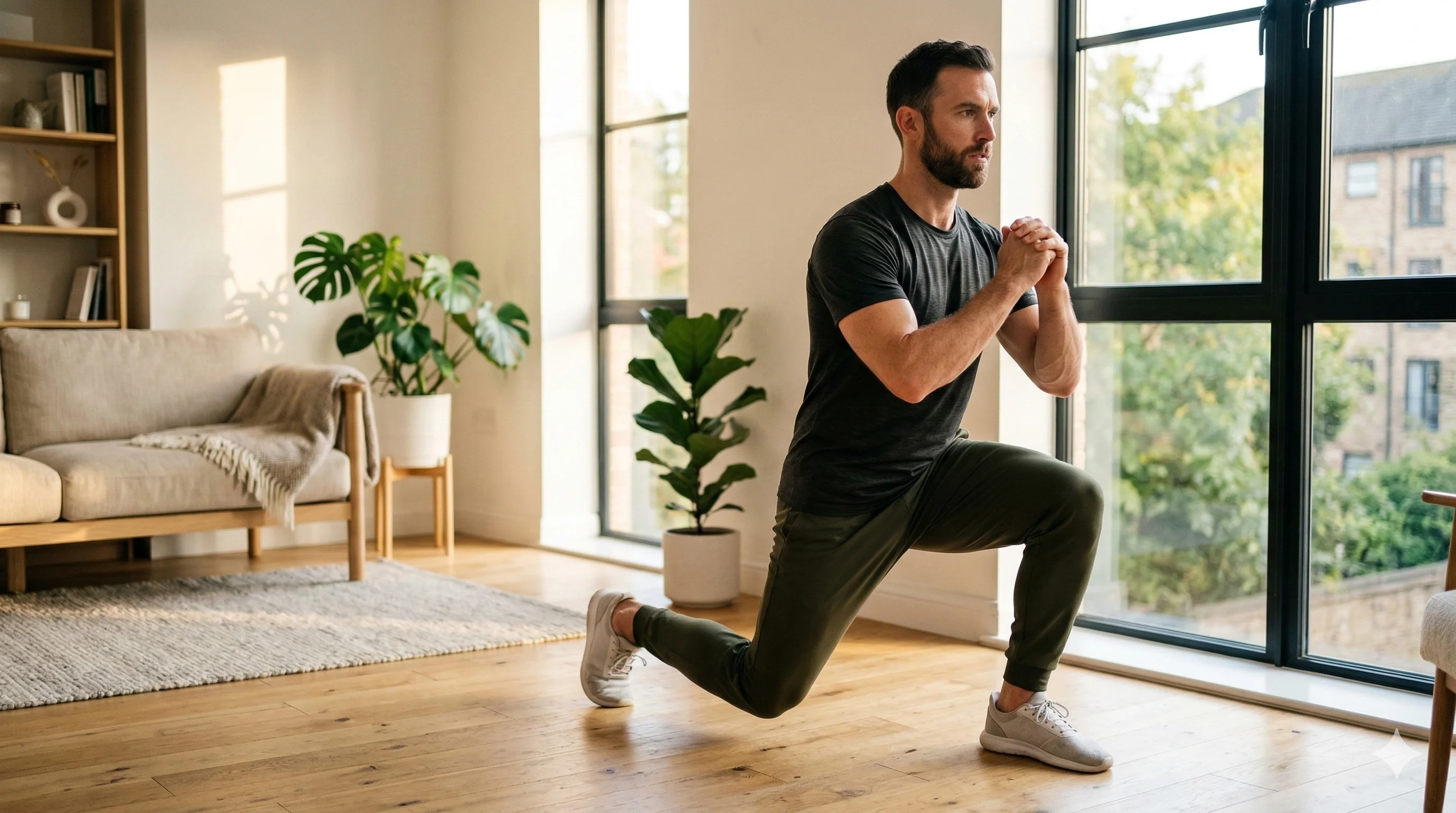
The essential unilateral movement for powerful, balanced legs. Lunges engage the quads, glutes and hamstrings while training balance and hip stability — a complete exercise that corrects imbalances between the right and left leg.
Execution
Stand with feet hip-width apart, eyes forward. Take a large step forward with one leg, keeping your torso upright and abs engaged. Bend both knees simultaneously until your back knee nearly grazes the floor (both knees at roughly 90°). Your front knee stays aligned with your toes without excessively passing over them. Drive firmly through the front heel to return to the starting position. Alternate legs or complete all reps on one side depending on the variation.
Breathing
Inhale as you lower under control, exhale as you push back up. Maintain deep, regular breathing — never hold your breath, especially at the end of a set when fatigue sets in.
Benefits
- •Develops unilateral strength and corrects muscular imbalances between the two legs
- •Intensely engages the glutes, which are often under-activated in bilateral movements like squats
- •Improves balance, proprioception and hip stability
- •Strengthens hip mobility and hip flexor flexibility
- •Direct carry-over to walking, running, climbing stairs and changes of direction
Variants
Alternating lunges
Step forward with the right leg, return, then step forward with the left. Trains both sides equally in the same set. Returning to standing between each rep adds a stabilization challenge.
Reverse lunges
The step goes backward instead of forward. Gentler on the knees because your weight stays naturally over the front heel. Ideal for those with patellar sensitivity.
Pause lunges
Hold the bottom position for 2–3 seconds before rising. The pause eliminates momentum and increases time under tension, intensifying quad and glute work.
Bulgarian split squats
Rear foot elevated on a chair or bench. Greatly increases load on the front leg and the stretch on the rear hip flexor. A demanding variation in strength and balance, reserved for those comfortable with standard lunges.
Curtsy lunges
The back foot crosses behind the standing leg in a curtsy. Targets the glute medius and adductors more, working lateral hip stability in a rarely trained plane of motion.
Lateral lunges
The step goes to the side instead of forward. Engages adductors and abductors in addition to quads and glutes. Excellent for hip mobility and preparation for lateral sports movements.
Walking lunges
Chain lunges by stepping forward continuously, like walking. The continuous motion adds a dynamic balance challenge and increases the cardiovascular component. Requires a few metres of space.
Jump lunges
Jump to switch legs in the lunge position. A plyometric version that develops explosiveness and spikes your heart rate quickly. Reserved for those who have mastered standard lunges and have no joint pain.
Our tips
- 1.Keep your torso upright and eyes forward — the natural tendency is to lean forward as fatigue sets in
- 2.The front knee must stay aligned with your second toe: if it caves inward, consciously activate your glute
- 3.Take a long enough step: too short puts excessive pressure on the front knee; too long throws off your balance
- 4.If balance is an issue, start with reverse lunges or place your hands on your hips to lower your center of gravity
Common mistakes
- •Front knee diving past the toes or caving inward — shorten your step and push the knee outward
- •Torso leaning forward — keep your chest tall and shoulders over your hips
- •Step too short turning the lunge into a partial squat — the front shin should be nearly vertical at the bottom
- •Back foot flat on the floor — only the ball of the back foot touches the floor; the heel stays raised
- •Lowering too fast without control — control the eccentric phase over 2 seconds to protect the knees and maximize muscle work