
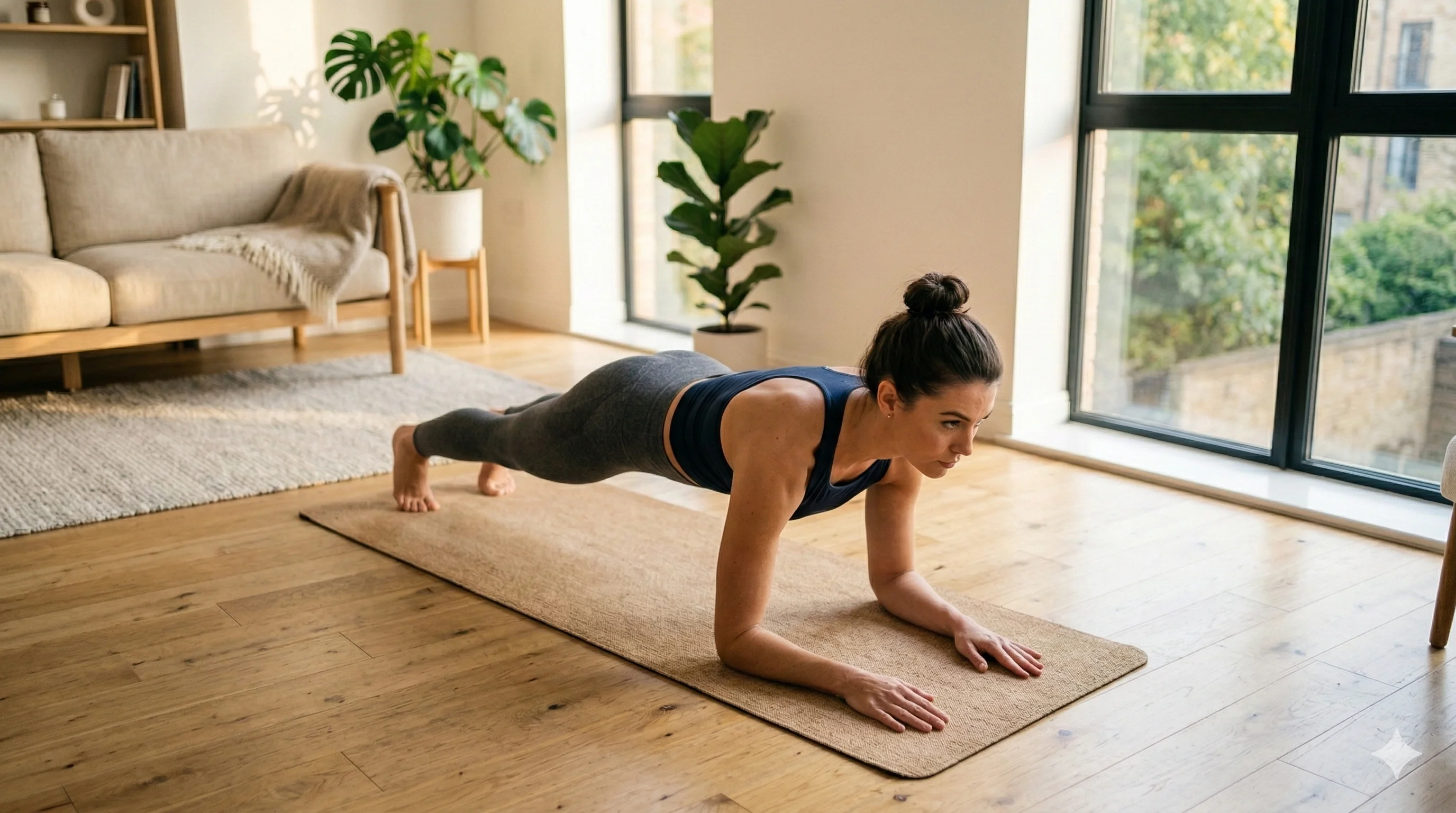
The foundational exercise for a strong core and a protected back. The forearm plank strengthens the deep abdominal belt without any movement: simply hold the position and resist gravity. A fundamental accessible to everyone.
Execution
On the floor, brace yourself on your forearms and the balls of your feet. Elbows placed directly under your shoulders, forearms parallel or hands clasped in front. Your body forms a straight line from head to heels: contract your abs by pulling your navel toward your spine, squeeze your glutes and push your heels backward. Eyes directed at the floor, between your hands, neck in line with your spine. Hold for the prescribed time while breathing steadily, never letting your hips sag or rise.
Breathing
Breathe normally and regularly through your nose and mouth. The natural tendency is to hold your breath — resist: use controlled diaphragmatic breathing, maintaining transverse contraction on each exhale.
Benefits
- •Strengthens the transverse abdominis, the deep muscle essential for core stability
- •Protects the lower back by improving posture control and intra-abdominal pressure
- •Engages the entire body isometrically: shoulders, back, glutes and thighs all contribute
- •No equipment needed and very low injury risk — accessible from day one
- •An essential foundation for all other exercises: push-ups, squats, burpees and everyday movements
Variants
Side plank
Supported on one forearm and the outer edge of the foot, body in profile. Targets the obliques and glute medius to strengthen lateral core stability. Alternate sides for balanced work.
Side plank on knees
Accessible version of the side plank: supported on the forearm and knee rather than the foot. Reduces leverage for beginners while still working the obliques and lateral stability. Ideal for building strength before progressing to the full version.
Superman plank
In the standard plank position, extend your arms forward like Superman in flight. Greatly increases leverage and difficulty by engaging the spinal erectors and shoulders more.
Shoulder tap plank
In a high plank, touch the opposite shoulder with each hand alternately. Adds an anti-rotation challenge: the core must resist twisting while you lift one hand.
RKC plank
Forearm plank with maximum full-body tension: try to bring your elbows toward your feet (without moving), make fists and contract every muscle. Much more intense than a standard plank — 10 seconds RKC equals 30 seconds standard plank.
Bear hold
On all fours, hands under shoulders, knees under hips, lift your knees 2–3 cm off the floor and hold. Works core stability in a shortened position that intensely engages the quads and transverse abdominis. An excellent transition exercise before the plank.
Hollow hold
Lying on your back, arms extended overhead and legs extended, lift your shoulders and feet off the floor while pressing your lower back into the floor. A gymnastics position that powerfully strengthens the rectus abdominis and transverse in a supine position.
Plank to downward dog
From a high plank, push your hips up and back into downward dog, then return to plank. The alternation trains shoulder mobility, hamstring flexibility and dynamic core stability. An excellent warm-up transition movement.
Our tips
- 1.Think about pushing the floor away from you with your forearms — this active shoulder engagement protects the joint and increases muscle recruitment
- 2.Squeeze your glutes as hard as your abs: they prevent the pelvis from tilting forward
- 3.Prefer several short sets with good form (4 x 20 s) over one long set where posture breaks down
- 4.Shaking is normal and means the muscles are working — if your back arches, stop and rest
Common mistakes
- •Hips sagging toward the floor (lower back arch) — the most common sign of fatigue. Contract your abs and glutes or stop the set.
- •Hips piking up — makes the exercise easier but eliminates the core training benefit. Your body must remain a straight line.
- •Elbows placed too far in front of your shoulders — places excessive strain on the shoulders. Elbows must be directly under the joints.
- •Head lifting to look forward — compresses the cervical spine. Keep your gaze at the floor, neck neutral in line with your spine.
- •Holding your breath — raises blood pressure and limits how long you can hold. Breathe calmly and steadily.