
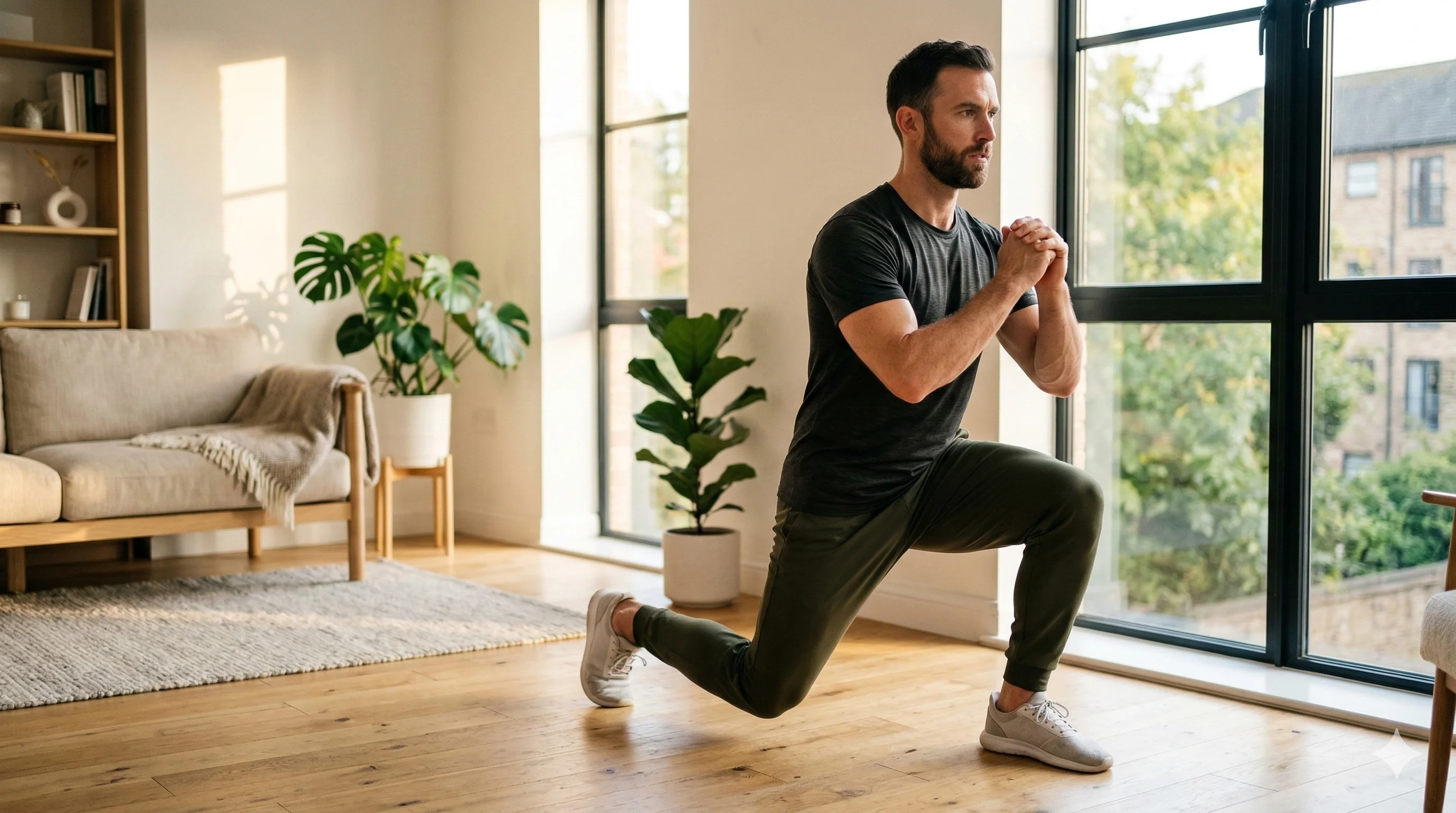
A hip hinge exercise that deeply targets the posterior chain. The good morning strengthens the hamstrings, spinal erectors and glutes through a controlled forward trunk flexion — essential for back health and posture.
Execution
Stand with feet shoulder-width apart, knees slightly bent (never locked). Place your hands behind your head or crossed on your chest. Keeping your back perfectly straight and chest tall, hinge your torso forward by pushing your hips back, as if trying to touch the wall behind you with your glutes. Lower until you feel a strong stretch in your hamstrings (torso roughly parallel to the floor depending on your flexibility). Contract your glutes and hamstrings to return your torso upright by driving your hips forward. The movement comes from the hips, never the lower back.
Breathing
Inhale deeply as you hinge forward, exhale as you rise while contracting your glutes. Keep your abs engaged throughout to protect your spine.
Benefits
- •Strengthens the entire posterior chain: hamstrings, spinal erectors and glutes
- •Improves hip mobility and hamstring flexibility dynamically
- •Teaches the hip hinge motor pattern, fundamental for lifting objects in daily life
- •Prevents lower back pain by strengthening the spinal stabilizer muscles
- •Prepares you for more advanced movements like the deadlift and kettlebell swing
Variants
Single-leg Romanian deadlift
The same hip hinge movement but on one leg, the free leg extending behind. Greatly increases balance work and hip stabilizer engagement.
Single-leg deadlift
Similar to the unilateral Romanian deadlift with an even greater balance challenge. The free leg aligns with the torso to form a horizontal line. Excellent for correcting muscular imbalances between the two sides.
Our tips
- 1.Maintain a slight knee bend throughout — locked knees place too much stress on the lower back
- 2.The movement comes from the hips, not the back: imagine your hips are a door hinge
- 3.Keep your gaze toward the floor about one metre in front of you to keep your neck aligned with your spine
- 4.Only lower as far as your back stays straight — never sacrifice posture for range of motion
Common mistakes
- •Back rounding on the way down — a sign you're going too low or your hamstrings lack flexibility. Reduce the range of motion.
- •Locked knees — always maintain a micro-bend to protect the lower back and allow free hip movement
- •Movement originating from the lower back instead of the hips — push your glutes back first; your torso follows naturally
- •Head lifting to look forward — keep your neck neutral; your gaze follows the movement of your torso
- •Uncontrolled fast descent — control the lowering phase over 2–3 seconds to maximize muscle work and protect your back