
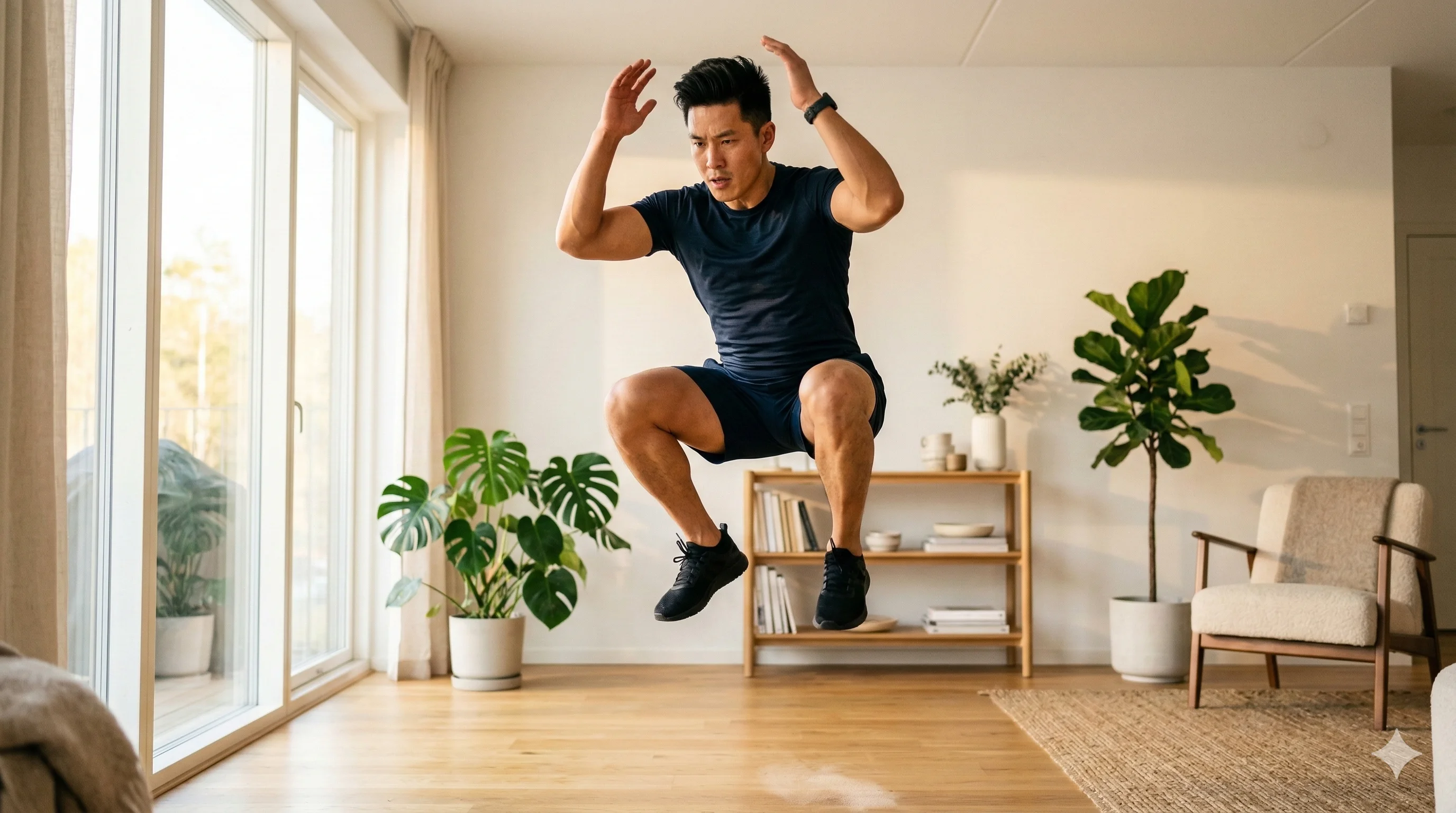
A lateral cardio exercise inspired by the speed skater's movement. Skaters develop leg power, single-leg balance and hip stability in an explosive, fluid motion.
Execution
Stand upright, shift your weight onto your right leg and push laterally to the left, leaving the floor. Land on your left foot, knee slightly bent, bringing your right leg behind your standing leg (foot barely touching the floor or not at all). Simultaneously, your right arm swings forward and your left arm swings back, like a skater. Immediately push back to the right. The movement is continuous, fluid and controlled: each landing is cushioned by a knee bend before exploding in the other direction.
Breathing
Exhale on each lateral push, inhale briefly during the flight phase. Your breathing rhythm naturally syncs with the back-and-forth motion.
Benefits
- •Works lateral leg power, a movement plane often neglected in standard training
- •Strengthens the glutes and adductors dynamically and functionally
- •Develops single-leg balance and hip and ankle stability
- •High cardio effect with lower impact than vertical jumps
- •Improves agility and rapid direction-change ability
Variants
Lateral bounds
Wider, more explosive lateral jumps with longer air time. Develops more power and lower-limb explosiveness. Requires good ankle stability.
Side shuffles
Lateral gliding steps without a flight phase. Reduces joint impact while working the adductors and lateral coordination. Ideal for warm-ups or beginners.
Our tips
- 1.Push hard through your standing leg into the floor — the explosiveness of that push is what makes the quality of the movement
- 2.Bend your knee on landing to absorb impact and prepare for the next push
- 3.Keep your torso slightly forward, like a real skater — it helps your balance
- 4.Start with moderate amplitude and progressively increase the width of your jumps
Common mistakes
- •Landing with a straight leg — always bend your knee on landing to protect your joints and maintain balance
- •Torso too upright — lean slightly forward to lower your center of gravity and improve stability
- •Too little amplitude (small steps instead of real lateral jumps) — actually push into the floor to cover ground
- •Arms staying still — use the natural arm swing for balance and power
- •Landing knee collapsing inward (valgus) — focus on knee-foot alignment on every landing